Gasless Minting Guide
Build a mint flow that feels closer to a consumer product than a wallet funding exercise. This guide explains when gasless minting makes sense, what it changes in the user journey, and how the current Gizmolab UI components map to a practical implementation path.
Gasless minting reduces one of the highest-friction moments in NFT onboarding: asking a new user to handle wallet funding before they can complete a first action. Instead of forcing every visitor through the same crypto-native setup path, you can guide them through sign-in, wallet creation, and transaction sponsorship in a way that feels more like product onboarding.
That matters when your goal is not only to expose a mint button, but to keep more users moving from interest to completion. For product teams building drops, gated experiences, collectibles, or digital ownership flows, the UX decision often matters as much as the smart contract itself.
What gasless minting changes
Gasless minting does not mean the transaction has no network cost. It means the end user is not asked to pay that cost in the normal wallet flow. That distinction is important because the UX win comes from removing user-facing friction, not from pretending the underlying transaction disappears.
In a conventional mint, the user often has to:
- connect or install a wallet
- switch to the right network
- hold enough native token for gas
- approve and sign the mint transaction
In a gasless flow, the product can guide sign-in and wallet setup, then handle the sponsored transaction path behind the scenes. The result is a mint experience that feels easier to trust, faster to complete, and more compatible with non-crypto-native audiences.
When this pattern is a strong fit
Gasless minting is usually worth the extra implementation effort when onboarding friction is a growth problem, not just a technical inconvenience.
- consumer NFT onboarding where first-time users should not fund a wallet before claiming
- campaign or loyalty experiences where the NFT is one step inside a broader product journey
- gated drops and activation flows that need clearer wallet creation and mint-state messaging
- teams comparing conventional wallet-connected minting against a more guided account-abstraction path
If your audience is already comfortable funding wallets and managing gas, a standard wallet-connected mint flow may be enough. In that case, the existing NFT Mint Card can be the simpler implementation path.
How the current Gizmolab UI repo maps to gasless minting
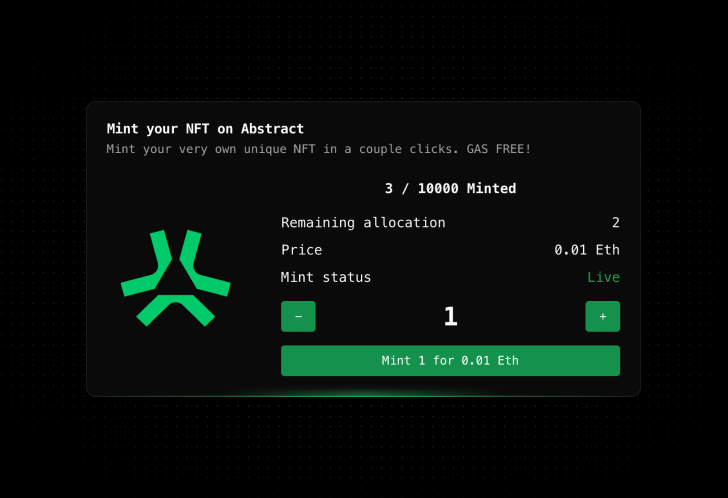
Abstract Gasless NFT Mint Component
The current component surface is built around an NFT contract address, a paymaster contract address, sponsored writes, live mint state, and a guided mint action.
Open related pageAbstract Sign In
Use the sign-in surface when you want a cleaner entry point before the mint itself, especially for users who should not start with a generic wallet workflow.
Open related pageAbstract Global Wallet setup
The docs layer already includes an Abstract provider setup pattern, which is the right foundation to stabilize before deeper mint customization begins.
Open related pageRecommended setup path
The safest way to evaluate gasless minting is to separate provider setup, mint UI behavior, and launch-specific business logic.
- Install the Abstract wallet dependencies and keep the provider setup isolated first.
- Wrap your app with the Abstract provider before debugging the mint surface itself.
- Prove the mint card works with known contract and paymaster addresses in a minimal route.
- Add sign-in, success states, and post-mint product logic only after the base path is stable.
- Verify network, sponsorship, and environment assumptions before making production-facing claims.
1. Install the Abstract wallet dependencies
The current Abstract-based path in this repo starts with the wallet provider and Wagmi dependencies:
2. Stabilize provider setup before debugging the mint
The current repo already includes an Abstract provider pattern. The example below mirrors the existing setup and keeps the initial focus on one job: making sure the app can support the wallet layer before you test mint interactions.
In the current implementation, the provider configuration is marked with testnet: true. Treat that as a signal to verify your actual target environment before describing production support more broadly.
3. Prove the mint surface with real contract inputs
The current gasless mint component expects both an NFT contract address and a paymaster contract address. That makes it a strong fit for teams that want a concrete sponsored-transaction demo instead of a generic placeholder card.
This component pattern is useful because it keeps the UX questions in one place: sign-in state, mint quantity, mint status, transaction feedback, and the sponsored write path all belong to the same reader journey.
What to show in a gasless mint UI
Collection context
Explain what the user is minting and why the action matters before they sign or click mint.
Availability and limits
Make supply, mint status, quantity limits, and timing visible instead of hiding them behind a failed transaction.
Wallet and sign-in state
Tell the user whether they need to sign in, create a wallet, reconnect, or wait for a loading state to resolve.
Transaction feedback
Show progress, success, and failure states clearly so a sponsored transaction never feels invisible or stuck.
Common implementation mistakes
Most gasless mint problems come from mixing too many layers into one debugging pass.
- trying to solve sign-in, sponsorship, contract wiring, and launch UX at the same time
- describing gasless support too broadly before verifying the live environment you actually use
- removing friction for the user but also removing clarity about status, limits, and outcomes
- treating a gasless mint card like a standalone feature instead of one step in a broader onboarding flow
Related docs and components
Use these pages to move from concept understanding into implementation detail:
- Abstract Gasless NFT Mint Component
- Abstract Sign In
- Install Abstract Global Wallet
- NFT Mint Card for a more conventional wallet-connected mint path
FAQ
What does gasless minting actually remove for the user?
It removes the normal requirement for the user to fund gas before the mint action. The transaction still has a network cost, but the user experience is abstracted so the person completing the mint does not handle gas in the usual wallet flow.
When is gasless minting a better fit than a standard mint UI?
It is usually a stronger fit when you want smoother first-use onboarding, campaign-driven NFT activation, or a consumer product flow where wallet funding should not be the first hurdle.
Which Gizmolab UI component is the most relevant starting point?
The clearest fit in the current repo is the Abstract Gasless NFT Mint Component, with Abstract Sign In and the Abstract Global Wallet setup guide covering the onboarding path around it.
Do I still need to think about contract and paymaster setup?
Yes. Gasless minting is not just a visual component choice. You still need a working contract, paymaster or sponsored-transaction path, and environment setup that matches the flow you plan to ship.
Should I publish chain-specific support claims on this page?
Only after verifying the live deployment and sponsorship configuration you actually want to support. This guide focuses on the implementation pattern and the current repo surfaces instead of promising broader production coverage by default.
"One of the only full-stack Web3 component libraries i've seen in the space so far. Ten out of ten recommended. Saved me a ton of time. Can't wait to see what templates they release next."
Samy
Side projects builder